
Ticks of Australia
Ticks are tiny arachnid parasites, found from tropical rainforests and coastal bushland to the arid inland. They feed on the blood of mammals, birds, reptiles, and even amphibians, playing a complex role in both wildlife ecology and human health. With over 70 native and introduced tick species recorded across the country, each adapted to different hosts and environments, their diversity reflects the vast range of habitats Australia offers.
There are still large gaps in our understanding of where different tick species occur, how their populations are changing, and what factors influence their distribution. Climate change, land-use shifts, and the movement of animals—both wild and domestic—may all be altering the range and abundance of ticks. Yet many records remain incomplete or outdated, making it difficult for scientists and health authorities to track trends or anticipate new areas of risk.

Ixodes holocyclus/Paralysis tick. Source: Ticksafety.com
Australia’s best-known species is the paralysis tick (Ixodes holocyclus), found primarily along the humid eastern coastline from Far North Queensland to eastern Victoria. Its toxin can cause paralysis in pets, livestock, and people. In more arid inland regions of Western Australia, South Australia and Queensland, the ornate kangaroo tick (Amblyomma triguttatum) is common, frequently parasitising macropods but also occasionally attaching to humans.
The bush tick (Haemaphysalis longicornis), an introduced species from Asia, is widespread along the east coast and often affects cattle, while brown dog ticks (Rhipicephalus sanguineus) thrive in warmer climates and readily infest domestic dogs, especially in northern Australia. The southern reptile tick (Bothriocroton hydrosauri) occurs mainly in south-eastern Australia.
Most ticks have four distinct stages of development; egg, larva, nymph and adult.
Ticks usually lay eggs in leaf litter or mulch. Once hatched, they must eat blood to survive. Larvae are tiny (1mm) and have only 6 legs. After their first meal, larvae drop off their host and moult to the 8-legged nymphal stage. Nymphs stay small, often < 2mm. A further blood meal allows nymphs to reach maturity by growing to adult size ticks.
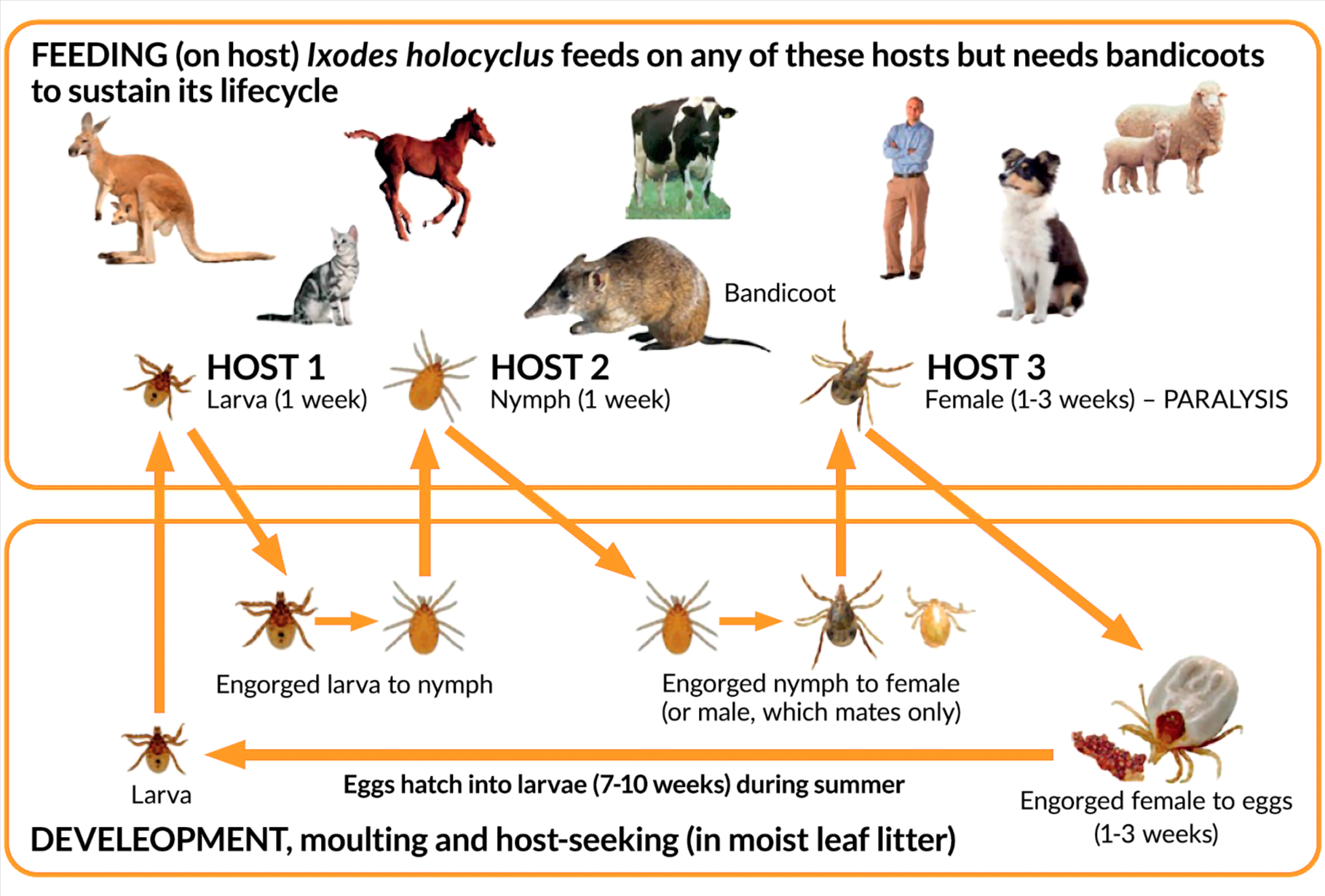
Ixodes feeding cycle. Source: Ticksofaustralia.org
More Information
Ticks of Australia: The species that infest domestic animals and humans [PDF] by SC Barker and AR Walker
Ticks of Australia: Biology of Key Species 15 minute webinar by SC Barker (-> Ticks of Australia website)

IDENTIFICATION TIPS
Count the legs:
Adult ticks and young ‘nymph’ ticks have 8 legs; larvae have 6.
Look at size and colour:
Male and female may be different sizes or colours. Engorged ticks turn grey or bluish, while unfed ticks are flat and brown.
Check the mouthparts:
Long, narrow mouthparts (in Ixodes) versus shorter, broader ones (in Rhipicephalus and Haemaphysalis).
Habitat clues:
Paralysis ticks prefer humid coastal forests, while ornate kangaroo ticks thrive in inland grasslands.